
Morgue Status
Watching historical stuff get bulldozed, but not the morgue. Why?

I live two miles from (what’s left of) the old Harrisburg State Hospital, a legit and actual lunatic asylum dating back to the mid-19th century. From the middle of that century to the middle of the 20th, the state erected over 50 buildings to house and treat the mentally ill and provide working space for all the staff and doctors. In the last few months, they’ve bulldozed most of it, except the morgue.
An extraordinary campus (self sufficient with its own farm, own water source, own power supply, own…morgue), it closed to mental health residents in 2006 with the rise of pharmaceuticals sedating the troubled in their own homes. I moved to town that year and, underemployed, I set about exploring the old place, then eventually walking my dog up there, because it was free, sublime, spooky, gorgeous, full of old trees, replete with fascinating architecture. I love a good ruin, and the HSH was many ruins.
Somewhat repurposed for government admin, it limped along until the pandemic, when all the buildings closed for good and immediately and dramatically fell into neglect. In 2024, the historical society offered a series of final tours of the key buildings and their underground tunnels and the Hollywood-famous building used in “Girl, Interrupted.” I was on one of the last tours. Then, of course, a company demolished most it, this year, to make way for a forensics lab. The whole area is fenced off and under guard because a few buildings remain and vandals are hot to steal a piece of history, and I’m bereft to have lost this place, this experience.
But I still walk near it, because the public greenbelt bike path skirts the edge. And I always walk by the hospital’s morgue, which faces the bike path. It’s basically on the bike path. Today was the first time it occurred to me that 1. the morgue is outside the fence and no one is guarding it and 2. It is slated for demolition but, oddly, has no demo date and 3. It’s not named as one of the buildings to be restored for historical purposes, but it should be. And, 4. It’s too damaged for restoration. And and and, 5. It’s just so perfect that the morgue, a place of liminality, of death but only recent death, is now one of the last buildings standing, and it exists in that liminal space again — someday, a gleaming forensics lab will supplant it, neighbor to it knows not what.
Here’s a photo I took today, October 13, 2025. That’s the morgue. Those are the dogs, you know them. I was struck that they were both looking at the morgue, but of course they were — dogs can see what we can’t. They know what’s there.
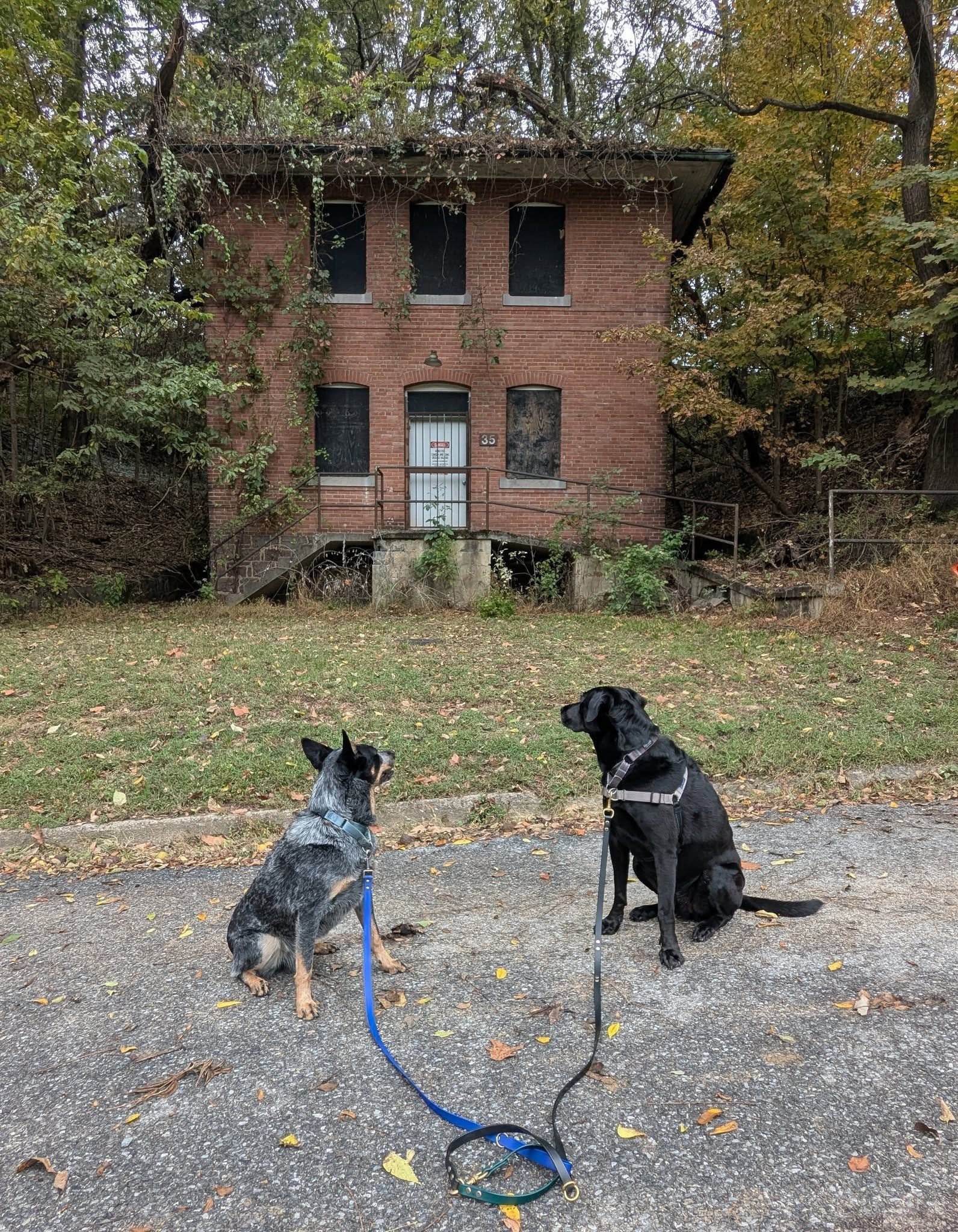
It was, and is, Building #35 in the chaotic numbering scheme of the 50+ buildings that as of today are down to about 12, and only 4 are set to be saved permanently for the “historical record” that matters but doesn’t. I’ve seen a video of the inside — first floor still has the autopsy table (as of this last summer, 2025). The second floor, at one time a top-notch pathology lab, is all empty cupboards and a rotting floor that is too dangerous. The basement, about the creepiest place you can imagine, has a tunnel that ended in a subterranean elevator (yep) that linked the morgue to the women’s ward on the hill. In the video, in the tunnel, there is a perfectly terrifying wheelchair.
All the buildings up on the hill were connected by tunnels, so, back in the day, a body could be moved to the morgue without catching the eyes of residents. Today, most of the fence around the demolition area is hung with miles of tarp, making it hard to see what they are doing up there. One thing they are doing is backfilling the tunnels. I know that because a local historian gets pictures and video with his drone — no fence or tarp can stop the drone from seeing. This is a place that has a history of obscuring and a fiercer history of trespassers ravenous to see more.
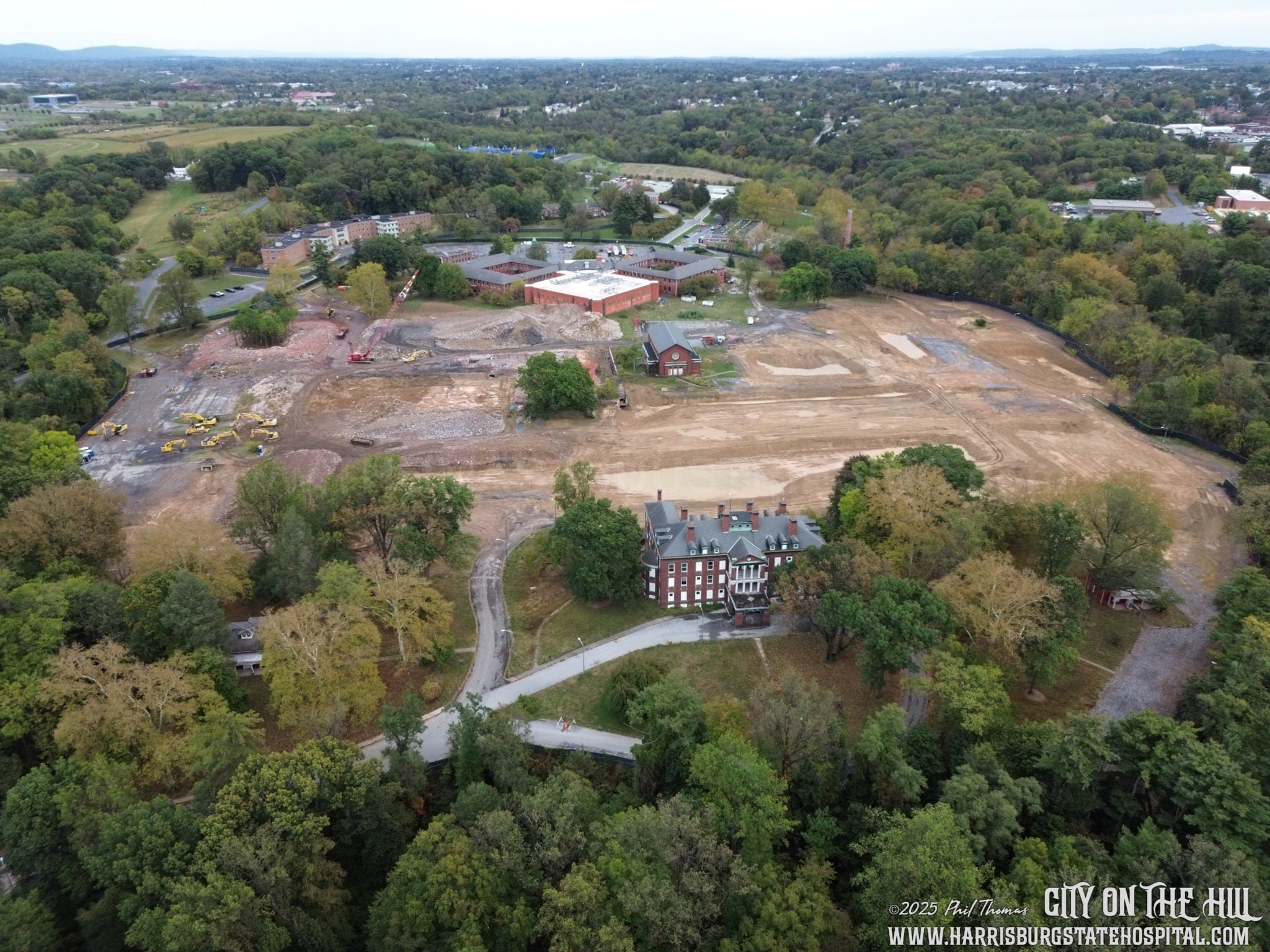
A few summers ago, turkey vultures nested on the roof of the morgue. I think it was the summer of 2023. Vultures, of course, are drawn to dead things, the corpses. They circle what’s dying or dead. They spend quality time with what needs to be gone. That summer, I marveled over the vultures’ choice of a rookery, which had more to do with a fallen tree as a frame for their nest, rather than the morgue as a place for, um, food. (It’s not housed bodies for a very long time.) This summer, the wildlife in general is down in numbers, given that most of their overgrown wild space has been leveled. To see how the greenery is all just dirt now, here’s a drone photo by Phil Thomas, taken this weekend and posted yesterday. The morgue, out of frame, is just off to the center right. I haven’t seen turkey vultures at all this year, but I also can’t get to the full area. They might be around. Or, they might have said, for the first time ever, there’s nothing left for us here.
I’m wondering if the morgue is going to survive this Halloween season — it’s ripe for the picking, so to speak, and that autopsy table is probably a prized find for the right freak or the underground collector of ephemera. Not everyone knows that it is a morgue. I only know because I bought a book about the HSH, and because I follow the local history buffs who documented the area. I’m surprised that no one has broken in. But on the other hand, it’s unmarked as a morgue and clearly marked as a lung cancer hazard — I found myself holding my breath while watching the video, it’s that bad inside with mold and rot and asbestos.
The morgue is about 100 yards from where I planted the Dawn Redwood, my stout and hardy sapling, grown from seed, who survived a pine tree falling on it back in May. I mention that because I try to tune in to essential small places, and I think this stretch of space between the redwood and the morgue might be a space tapping in to me, or me into it. But it didn’t occur to me until today. Ley lines and whatnot. Thin places (where history slips through, or up, and we catch it in the modern moment). Or a “vortex,” as the rather dramatic ghost hunter shows that Paul watches like to call it. (I don’t think of the space as a vortex). But then of course I think of the vultures vortexing down to their roost.
I’m going to keep my eye on it. Morgue Status, to go with any Rescue Dawn Redwood Updates. I keep thinking about how this area is going to be shined up with little trees and boring lawn, shined into a cutting edge forensics lab — a place for new techniques to detect crime. But will the past slip into the new forensics, skewing all the calibrations in a phenomenal haunting? Will the demolition, itself a crime if you think about it, fuzz out the edges of 21st century confidence? I kinda hope so. Where will the vultures settle, and if I watch for their shadows first and their bodies second, like something coming at me down that long tunnel in the hill, will I find their new home and see what they see? A girl, interrupted, can hope.
Jen Hirt is the author of the memoir Under Glass, the essay collection Hear Me Ohio, and the poetry chapbook Too Many Questions About Strawberries. She is the co-editor of two anthologies: Creating Nonfiction: Twenty Essays and Interviews with the Writers; and Kept Secret: The Half-Truth in Nonfiction. She is a professor at Penn State Harrisburg. Read more of her work at jenhirt.ink.